
AI-OCR for Regulated Industries: A Practical Guide for System Integrators
Banks, insurers, hospitals, and government bodies still run on paper. Loan applications, KYC forms, claims, prescriptions, customs declarations, and signed contracts arrive every day as scans, PDFs, and phone photos. Someone has to read them, check them, and type the data into a core system.
AI-OCR changes that work. For system integrators, it is also one of the clearest ways to deliver fast, measurable value to clients in regulated sectors. This article explains what AI-OCR is, why regulated industries need a different approach, and what a solid deployment looks like.
What AI-OCR actually is
Classic OCR turns an image of text into machine-readable characters. It works well on clean, typed pages with a fixed layout. Give it a crooked scan, a handwritten field, or a form it has never seen, and accuracy drops fast.
AI-OCR adds machine learning on top. It reads the text, then understands the document around it. It can tell an invoice from a bank statement, find the policy number wherever it sits on the page, read handwriting, and handle Arabic and English on the same form.
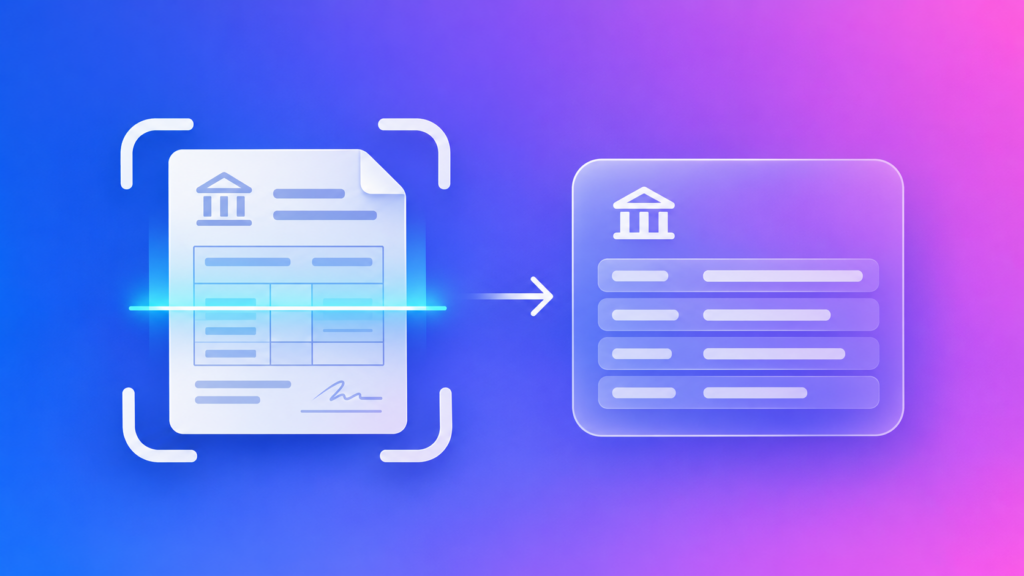
The practical difference for your client is simple. Classic OCR gives them text. AI-OCR gives them structured data they can push straight into a workflow, with a confidence score attached to every field. Combine that with classification, validation, and routing, and you have full intelligent document processing.
Why regulated industries need more than good accuracy
In a retail back office, a misread field is an annoyance. In a bank or a hospital, it can mean a compliance breach, a wrong payment, or a patient safety issue. That raises the bar in four areas.
Accuracy you can prove. Regulators and auditors want to know how a decision was made. The system must show the source image, the extracted value, and who approved it.
Human review where it matters. Low-confidence fields should route to a person automatically. High-confidence fields can flow straight through. Getting this threshold right is where most of the value sits.
Data residency and privacy. Many central banks and health authorities require sensitive data to stay in-country or inside the client’s own environment. Cloud-only tools often fail this test, so on-premises or private cloud options matter.
A full audit trail. Every document, every edit, and every export needs a log that holds up years later.
Where it pays off first
The best starting points are high-volume, rules-heavy processes where staff spend hours rekeying data.
| Sector | Typical documents | What AI-OCR improves |
|---|---|---|
| Banking and fintech | KYC forms, IDs, bank statements, cheques, trade finance papers | Faster onboarding, fewer manual checks, cleaner AML records |
| Insurance | Claim forms, medical reports, repair invoices, policies | Shorter claim cycles, earlier fraud flags |
| Healthcare | Referrals, prescriptions, lab results, insurance approvals | Less admin for clinical staff, fewer data entry errors |
| Government and public sector | Permits, customs declarations, civil records, tax forms | Shorter queues, searchable archives, consistent processing |
A focused pilot on one document type usually shows results within weeks. That early win makes the case for wider rollout much easier.
What system integrators should get right
The OCR engine is only one part of the project. The integration work around it decides whether the client sees real results.
- Start with the process, not the tool. Map how documents move today, where they stall, and who touches them. Then decide where extraction fits.
- Plan the integration early. Extracted data is only useful once it reaches the core banking system, ERP, claims platform, or EHR. Agree on APIs, data formats, and field mapping before the pilot starts.
- Design the review loop. Set confidence thresholds with the client’s compliance team, build a simple review screen, and feed corrections back to improve the model.
- Match the deployment model to the rules. Check local data regulations first. Offer on-premises or private cloud where the client needs it.
- Test with real documents. Use the client’s own messy scans, stamps, handwriting, and mixed languages. Clean samples hide problems.
- Measure from day one. Track straight-through processing rate, handling time per document, and error rate. These numbers sell the next phase.
The opportunity for integrators
Regulated organizations want automation, but they cannot take risks with compliance. They need a partner who understands their systems, their regulators and their data rules. That is the integrator’s natural role.
AI-OCR gives you a solution that is easy to explain, quick to pilot, and simple to measure. Start with one painful document process, prove the numbers, and you open the door to a much larger automation roadmap with the same client.